
Why Airports Expand Their Terminals
Several factors drive terminal expansion projects.
The most common reasons include:
- Passenger growth
- Airline expansion
- Increased international traffic
- New security requirements
- Aging infrastructure
- Commercial development opportunities
- Improved passenger experience goals
Many airports were originally designed decades ago and were not built to accommodate current traffic volumes.
As demand continues to grow, expansion becomes necessary to avoid congestion and operational inefficiencies.
Recognizing Capacity Constraints
Before planning an expansion, airports must understand where capacity limitations exist.
Common bottlenecks include:
- Check-in areas
- Security screening checkpoints
- Immigration facilities
- Boarding gates
- Baggage claim areas
- Passenger circulation spaces
- Aircraft contact stands
Understanding these constraints allows developers to target investments where they will generate the greatest benefits.
Extending Existing Terminal Buildings
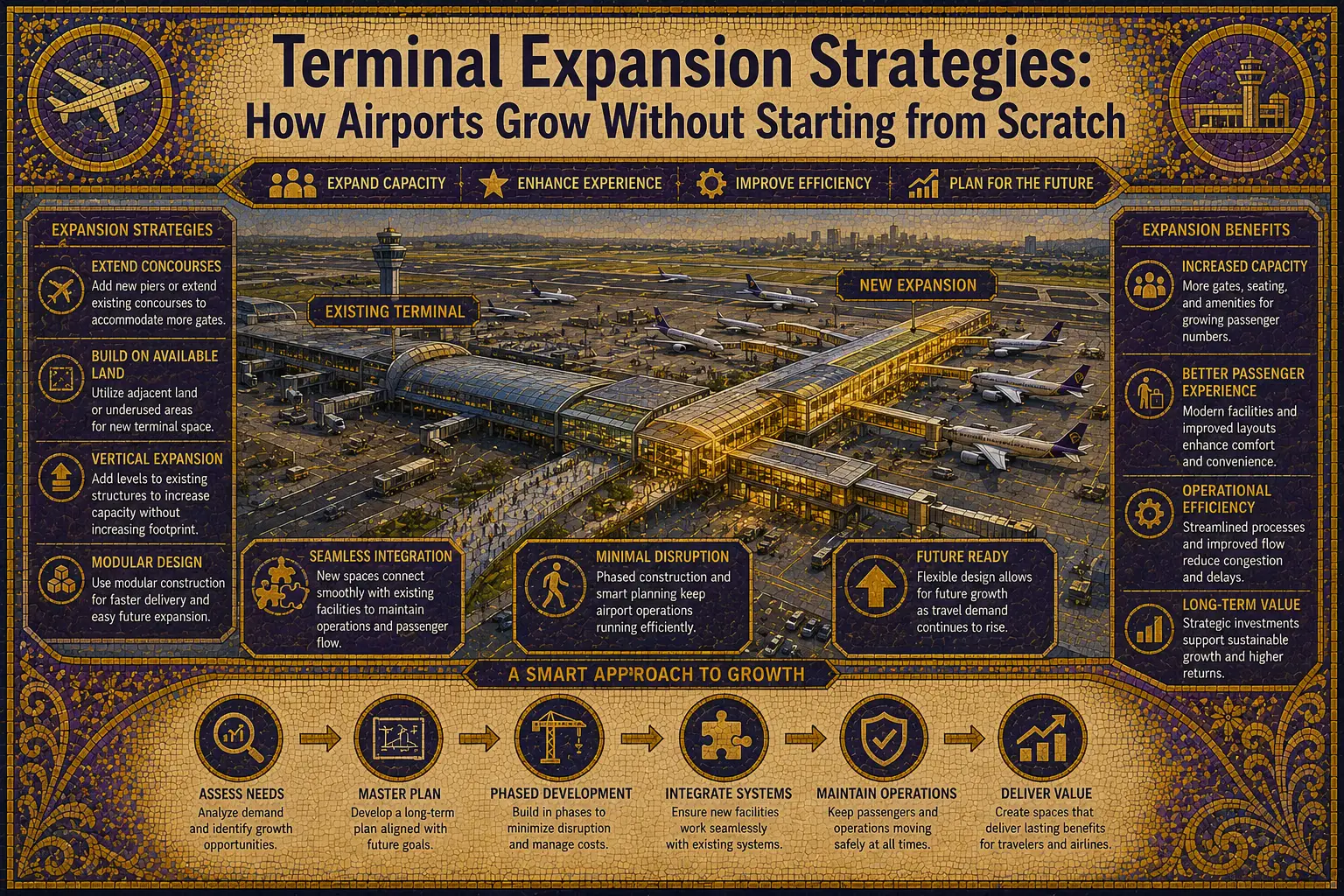
One of the most common expansion strategies is physically extending the existing terminal.
This approach may involve adding:
- New gates
- Additional waiting areas
- Expanded check-in facilities
- Additional baggage systems
- New retail spaces
Terminal extensions can often be integrated into existing operations while minimizing disruption.
However, structural limitations and site constraints may restrict future expansion opportunities.
Building Terminal Wings or Piers
Many airports increase capacity by constructing additional terminal wings or gate piers.
This approach offers several advantages:
- Additional aircraft contact stands
- Increased gate capacity
- Improved passenger flow
- Greater operational flexibility
New piers can often be added without significantly affecting the main terminal building.
This strategy is widely used by large international airports facing rapid growth.
Constructing Satellite Terminals
Some airports choose to develop satellite terminals connected to the main terminal by:
- Automated people movers
- Underground tunnels
- Walkways
- Shuttle buses
Satellite terminals can provide significant additional capacity without requiring major modifications to the original terminal.
They also allow airports to expand gradually over time.
However, this approach often requires substantial investment in transportation systems and supporting infrastructure.
Developing New Terminal Buildings
In some cases, expanding an existing terminal is no longer practical.
Airports may instead construct an entirely new terminal while maintaining operations in the existing facility.
This approach can:
- Increase overall capacity significantly
- Modernize passenger facilities
- Improve operational efficiency
- Create opportunities for future growth
Although more expensive, a new terminal may offer greater long-term benefits than continuously expanding an outdated facility.
Reconfiguring Existing Space
Not all expansion strategies require new construction.
Many airports increase capacity by improving how existing space is used.
Examples include:
- Relocating offices
- Reconfiguring security areas
- Expanding self-service technologies
- Improving passenger circulation
- Consolidating operational functions
Operational improvements can often provide meaningful capacity increases at relatively low cost.
Using Technology to Increase Capacity
Modern technology allows airports to process more passengers within the same physical space.
Examples include:
- Self-service check-in kiosks
- Automated baggage systems
- Biometric processing
- Digital wayfinding
- Automated border control systems
Technology investments can delay the need for major construction projects and improve passenger experience.
Modular Expansion Strategies
Many airports now design terminals with future expansion in mind.
Modular approaches allow terminals to grow incrementally through:
- Expandable gate areas
- Additional processing zones
- Flexible building layouts
- Reserved expansion areas
This strategy reduces future costs and simplifies long-term development.
Expanding Landside Infrastructure
Terminal expansion often requires improvements beyond the terminal building itself.
Supporting infrastructure may include:
- Additional parking facilities
- Expanded road access
- Public transportation improvements
- Utility upgrades
- New hotels and commercial developments
Ignoring landside requirements can create new bottlenecks even after terminal expansion is completed.
Maintaining Operations During Expansion
One of the biggest challenges in terminal expansion is keeping the airport operational during construction.
Developers often rely on:
- Phased construction
- Temporary facilities
- Night work
- Temporary passenger routing
- Construction segregation measures
Maintaining passenger safety and minimizing disruption are critical priorities throughout the project.
Commercial Opportunities
Terminal expansion also creates opportunities to increase non-aeronautical revenues.
New facilities may include:
- Additional retail space
- Restaurants and lounges
- Premium passenger services
- Advertising opportunities
- Commercial developments
For many airports, commercial revenue growth is an important factor supporting investment decisions.
Sustainability Considerations
Modern terminal expansions increasingly incorporate sustainability objectives.
Examples include:
- Energy-efficient building systems
- Natural lighting
- Water conservation measures
- Renewable energy integration
- Sustainable materials
Sustainability initiatives can reduce long-term operating costs and improve environmental performance.
Planning for Future Growth
Terminal expansion should never focus solely on immediate capacity requirements.
Developers should also consider:
- Long-term passenger forecasts
- Future airline requirements
- Technology changes
- Additional expansion opportunities
- Operational flexibility
Airports that fail to protect future expansion opportunities often face expensive redevelopment projects later.
Choosing the Right Expansion Strategy
There is no universal solution for terminal expansion.
The optimal strategy depends on factors such as:
- Available land
- Existing infrastructure
- Financial resources
- Traffic forecasts
- Operational requirements
- Long-term development objectives
Each airport requires a tailored approach that balances immediate needs with future growth potential.
Conclusion
Terminal expansion is one of the most important challenges facing modern airports. Growing passenger demand, changing airline requirements, and evolving technologies require airports to continuously adapt and expand their infrastructure.
Successful terminal expansion strategies go far beyond simply adding more space. They require careful planning, operational coordination, long-term vision, and a strong understanding of future demand.
For airport developers and investors, well-planned terminal expansion projects can improve operational efficiency, increase revenues, enhance passenger experience, and position airports for decades of future growth.