
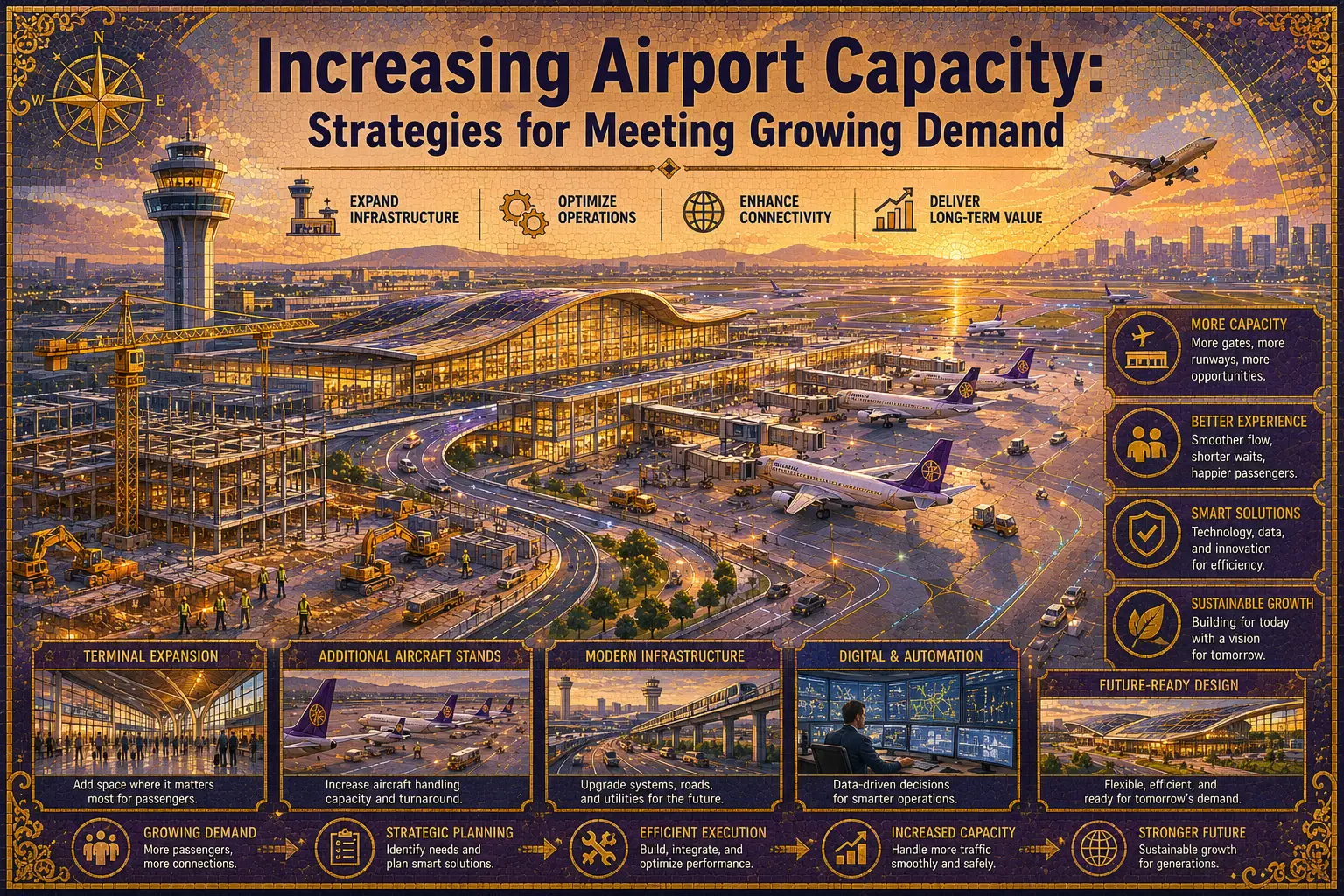
What Is Airport Capacity?
Airport capacity refers to the maximum number of aircraft movements, passengers, or cargo volumes that an airport can safely and efficiently handle over a given period.
Capacity limitations can occur in several areas:
- Runways
- Taxiways
- Passenger terminals
- Aircraft gates
- Security checkpoints
- Baggage systems
- Road access
- Cargo facilities
Because airports function as integrated systems, a bottleneck in one area can limit the performance of the entire airport.
Why Airport Capacity Matters
Insufficient capacity can lead to:
- Flight delays
- Congestion
- Reduced passenger satisfaction
- Higher operating costs
- Lost economic opportunities
- Reduced airline competitiveness
Conversely, increasing airport capacity can:
- Support economic growth
- Improve connectivity
- Attract new airlines
- Increase revenues
- Improve operational efficiency
Capacity planning is therefore one of the most important responsibilities of airport developers and operators.
Improving Runway Capacity
Runways are often the primary constraint at busy airports.
Several strategies can increase runway capacity, including:
- Optimizing runway configurations
- Building rapid exit taxiways
- Improving air traffic management
- Reducing runway occupancy times
- Implementing advanced navigation technologies
In some cases, airports may construct additional runways to support long-term growth.
However, runway expansion is often expensive and can face environmental and regulatory challenges.
Optimizing Taxiway Systems
Poor taxiway layouts can significantly reduce airport efficiency.
Improvements may include:
- Additional taxiways
- New high-speed exits
- Reduced aircraft crossing points
- Improved aircraft routing
Better taxiway design can increase aircraft movements without requiring additional runways.
This often represents one of the most cost-effective methods of improving airfield performance.
Expanding Terminal Capacity
Passenger terminals frequently become major bottlenecks as demand grows.
Airports can increase terminal capacity through:
- Terminal extensions
- Additional gate areas
- Satellite terminals
- Reconfigured passenger flows
- New check-in facilities
Expanding terminals can improve both operational performance and passenger experience.
Increasing Processing Efficiency
Technology has created new opportunities to process more passengers within the same physical space.
Examples include:
- Self-service check-in
- Automated baggage drop
- Biometric processing
- Automated border control systems
- Digital boarding technologies
Improved processing efficiency can significantly increase capacity without major construction projects.
Optimizing Gate Utilization
Aircraft gates represent valuable airport assets.
Capacity can often be increased by improving gate management through:
- Better scheduling
- Faster aircraft turnaround times
- Flexible gate allocation
- Improved operational coordination
Many airports have increased capacity simply by making better use of existing infrastructure.
Expanding Landside Infrastructure
Increasing airport capacity also requires improvements outside the terminal.
Important considerations include:
- Access roads
- Parking facilities
- Public transportation connections
- Utility systems
- Commercial developments
Failure to improve landside infrastructure can create new bottlenecks even if airside and terminal capacities are increased.
Expanding Cargo Capacity
For cargo airports, capacity constraints may arise from:
- Warehouse limitations
- Truck congestion
- Aircraft parking shortages
- Cold storage limitations
- Customs processing bottlenecks
Cargo capacity can often be increased through:
- Additional warehousing
- Improved logistics processes
- Technology investments
- Better infrastructure utilization
As global trade and e-commerce continue to grow, cargo capacity planning is becoming increasingly important.
Operational Improvements
Not all capacity increases require major construction projects.
Operational improvements may include:
- Better scheduling practices
- Improved coordination between stakeholders
- Enhanced data sharing
- Process optimization
- More efficient resource allocation
In some cases, operational improvements can provide substantial capacity gains at relatively low cost.
Using Technology to Increase Capacity
Technology is playing an increasingly important role in airport capacity management.
Examples include:
- Artificial intelligence
- Predictive analytics
- Digital twins
- Real-time operational monitoring
- Advanced airport management systems
These technologies allow airports to make better use of existing infrastructure and improve decision-making.
Building Additional Infrastructure
When optimization measures are no longer sufficient, airports may need to construct additional infrastructure.
This may include:
- New runways
- Additional terminals
- New cargo facilities
- Additional parking stands
- Expanded utility systems
Large infrastructure projects require significant investment and long-term planning but may be essential for supporting future demand.
Balancing Capacity and Sustainability
Increasing capacity must also consider environmental and social factors.
Developers increasingly evaluate:
- Noise impacts
- Carbon emissions
- Energy consumption
- Land use considerations
- Community concerns
Modern airport development seeks to balance growth with long-term sustainability objectives.
Forecasting Future Demand
Capacity planning depends heavily on understanding future demand.
Forecasting typically considers:
- Passenger growth
- Airline strategies
- Economic development
- Tourism trends
- Cargo growth
- Demographic changes
Forecasting is never perfect, but it provides the foundation for making informed investment decisions.
Planning for Long-Term Growth
Airport infrastructure often remains in service for several decades.
Capacity improvements should therefore consider:
- Future expansion opportunities
- Technological change
- Market evolution
- Long-term economic trends
Airports that fail to plan for future growth may quickly encounter new capacity constraints.
The Importance of Integrated Planning
Increasing airport capacity requires a system-wide approach.
Runways, terminals, roads, utilities, and operational processes must all work together.
Investing heavily in one area while neglecting another can simply shift bottlenecks elsewhere.
Successful airports therefore view capacity planning as an integrated and continuous process rather than a one-time project.
Conclusion
Increasing airport capacity is one of the most important challenges facing modern aviation infrastructure. Growing demand for passenger and cargo services requires airports to continuously improve their ability to accommodate more traffic while maintaining safety and efficiency.
Capacity can be increased through infrastructure expansion, operational improvements, technology adoption, and better utilization of existing assets.
For airport developers and operators, successful capacity planning is essential to supporting economic growth, improving competitiveness, and ensuring that airports remain capable of meeting future demands.