
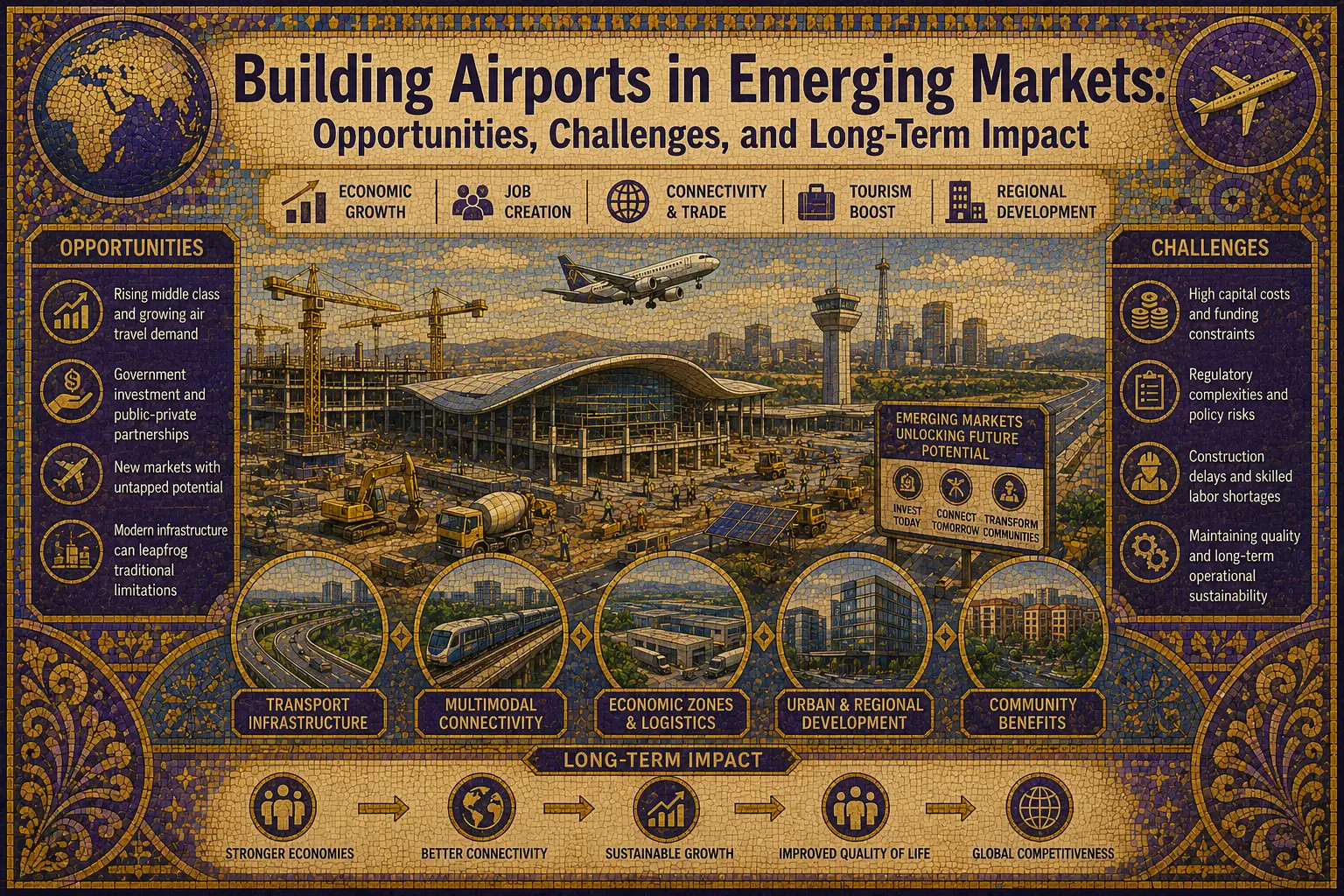
Why Emerging Markets Need New Airports
Many emerging economies are experiencing rapid growth in both passenger and cargo demand.
Several factors are driving this expansion:
- Population growth
- Rising household incomes
- Growth in tourism
- Expanding trade and logistics activities
- Urbanization
- Economic development initiatives
In many cases, existing airports are already operating near capacity or are unable to support future growth.
New airport development therefore becomes a critical component of national infrastructure planning.
Airports as Economic Development Engines
Airports are far more than transportation facilities.
They create economic value by:
- Supporting tourism
- Attracting investment
- Facilitating trade
- Creating employment
- Improving regional connectivity
- Encouraging industrial development
For emerging markets, airports can become catalysts for broader economic transformation.
Many governments view airport infrastructure as a strategic investment that can accelerate long-term development.
The Opportunity for Greenfield Development
Unlike mature markets, many emerging economies still have opportunities to build entirely new airports on undeveloped land.
Greenfield projects offer several advantages:
- Greater design flexibility
- Long-term expansion potential
- Modern infrastructure from the beginning
- Better integration of new technologies
- More efficient layouts
Developers can create airports designed for future demand rather than being constrained by historical infrastructure.
Limited Existing Infrastructure
One of the biggest challenges in emerging markets is the lack of supporting infrastructure.
Airport development often requires investment in:
- Roads
- Rail connections
- Utilities
- Water systems
- Telecommunications
- Power infrastructure
In some cases, the airport developer may need to participate in delivering infrastructure that would normally be provided by public authorities.
This can significantly increase project complexity and costs.
Financing Challenges
Airport construction requires substantial capital investment.
Financing challenges in emerging markets may include:
- Limited public budgets
- Higher borrowing costs
- Currency risks
- Political uncertainty
- Lower credit ratings
- Limited access to long-term financing
As a result, many governments seek alternative financing structures such as:
- Public-private partnerships
- Concessions
- Infrastructure funds
- Development bank financing
- Foreign direct investment
Attracting investment often depends on demonstrating long-term economic viability.
Demand Forecasting Uncertainty
Forecasting future traffic in emerging markets can be particularly challenging.
Passenger and cargo growth may be influenced by:
- Economic cycles
- Political developments
- Airline strategies
- Exchange rates
- Infrastructure investments
- Regional competition
Because many emerging markets have limited historical aviation data, forecasting often involves a higher degree of uncertainty.
Developers must therefore balance ambition with realistic market assumptions.
Regulatory and Institutional Challenges
Emerging markets often face regulatory complexities that can affect project delivery.
Potential challenges include:
- Changing legislation
- Lengthy approval processes
- Unclear institutional responsibilities
- Limited regulatory capacity
- Bureaucratic delays
Strong governance frameworks are essential to maintaining investor confidence and ensuring efficient project execution.
Land Acquisition and Social Considerations
Securing land for airport development can be difficult in rapidly developing regions.
Challenges may include:
- Land ownership disputes
- Relocation requirements
- Community opposition
- Compensation negotiations
- Environmental concerns
Stakeholder engagement becomes particularly important in emerging markets where infrastructure projects can have significant social impacts.
Building for Future Growth
Many airports in developing countries are constructed with future expansion in mind.
Long-term planning may include:
- Additional runways
- Future terminal expansions
- Cargo zones
- Logistics parks
- Commercial developments
- Airport cities
Building sufficient flexibility into the master plan can prevent costly modifications in the future.
Cargo and Logistics Opportunities
Many emerging markets are increasingly integrated into global supply chains.
This creates opportunities for airports to develop:
- Air cargo facilities
- E-commerce logistics centers
- Pharmaceutical infrastructure
- Cold chain facilities
- Manufacturing zones
Cargo operations can become an important source of revenue and economic activity, particularly in regions seeking to diversify their economies.
Technology Leapfrogging
One advantage of greenfield airport development in emerging markets is the ability to adopt modern technologies from the beginning.
New airports can incorporate:
- Digital infrastructure
- Automated systems
- Smart building technologies
- Renewable energy systems
- Modern security technologies
Without the limitations of legacy infrastructure, emerging markets can sometimes adopt innovations more quickly than mature airports.
Sustainability Considerations
Sustainability is becoming increasingly important in airport development worldwide.
Emerging market projects increasingly consider:
- Energy efficiency
- Renewable energy
- Water management
- Climate resilience
- Carbon reduction strategies
Building sustainable infrastructure from the beginning can reduce operating costs and improve long-term competitiveness.
The Importance of Public-Private Partnerships
Public-private partnerships have become a popular model for airport development in emerging markets.
These partnerships can offer several benefits:
- Access to private capital
- International expertise
- Improved efficiency
- Better risk sharing
- Long-term operational experience
When properly structured, public-private partnerships can accelerate infrastructure development while reducing pressure on public finances.
Political and Economic Risks
Emerging markets often present higher levels of uncertainty.
Potential risks include:
- Political instability
- Currency fluctuations
- Regulatory changes
- Economic downturns
- Shifting government priorities
Investors and developers must carefully assess these risks and develop strategies to mitigate their potential impact.
The Rise of Airport Cities and Economic Zones
Increasingly, airports in emerging markets are being developed as broader economic ecosystems.
Projects may include:
- Logistics zones
- Industrial parks
- Commercial real estate
- Free trade zones
- Business parks
- Manufacturing clusters
These developments can generate additional revenue and increase the economic impact of the airport.
The airport increasingly becomes a platform for regional economic development rather than simply a transportation facility.
Lessons for Successful Airport Development
Experience from successful projects around the world highlights several key principles:
- Develop realistic demand forecasts.
- Secure strong political support.
- Plan for long-term expansion.
- Build resilient financing structures.
- Prioritize connectivity and supporting infrastructure.
- Engage stakeholders early.
- Integrate sustainability from the beginning.
- Focus on economic development opportunities beyond aviation.
These principles can significantly improve the likelihood of long-term success.
Conclusion
Building airports in emerging markets presents both tremendous opportunities and significant challenges. Growing demand for air transportation, expanding trade, and increasing urbanization are creating strong needs for new airport infrastructure across many developing economies.
At the same time, developers must navigate financing constraints, regulatory complexities, infrastructure limitations, and political risks.
When carefully planned and executed, airport projects can become powerful engines of economic growth, improve regional connectivity, and create long-term value for communities, governments, and investors alike.