
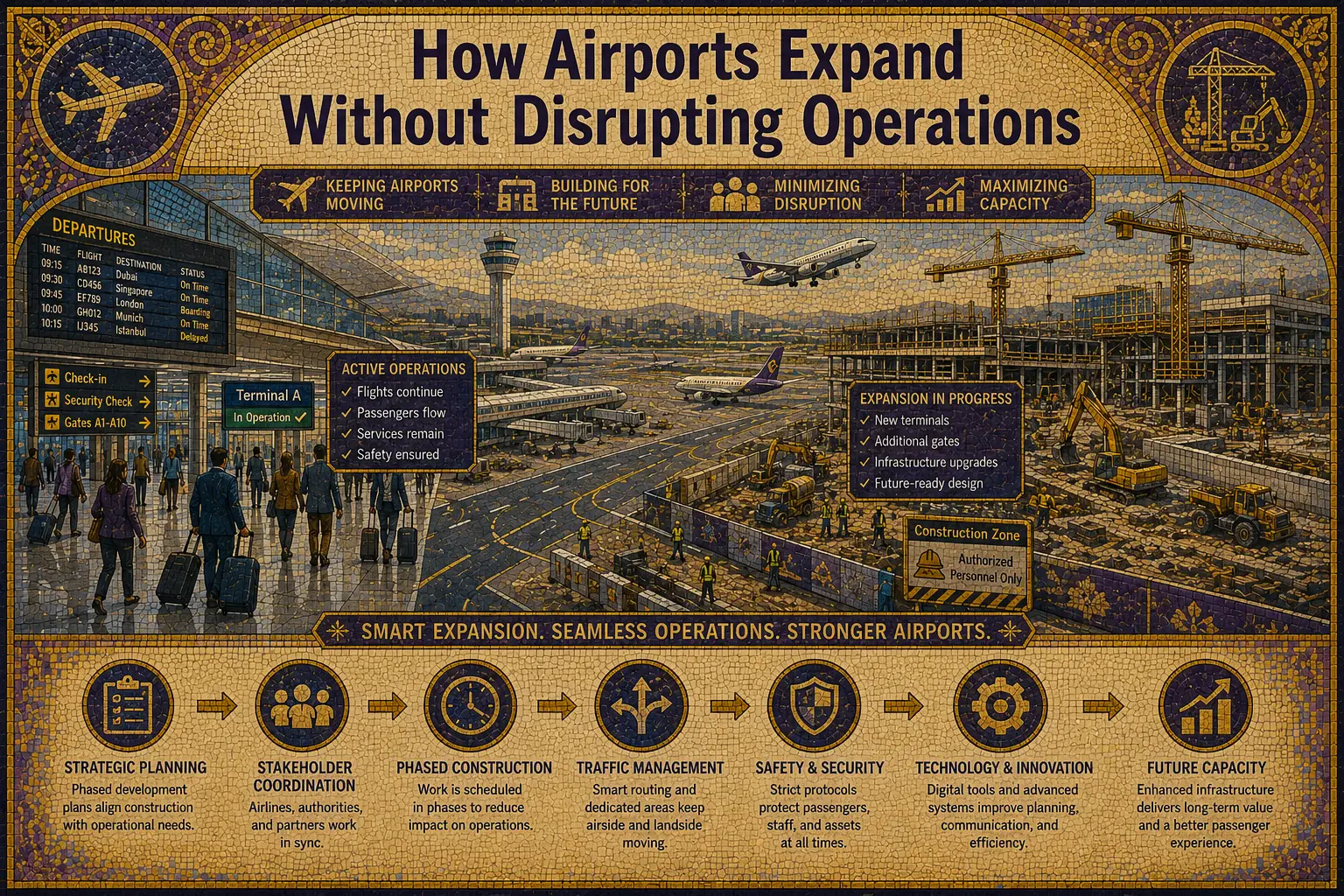
Why Airport Expansion Is Necessary
Airport expansion is typically driven by several factors:
- Passenger growth
- Increasing cargo demand
- Airline network expansion
- Aging infrastructure
- Regulatory requirements
- New technologies
- Commercial development opportunities
Many airports were built decades ago and were not designed to handle today’s traffic levels.
Expansion projects therefore become essential to maintaining competitiveness and supporting long-term growth.
The Unique Challenge of Operating During Construction
Most infrastructure projects can temporarily close sections of a facility during construction.
Airports rarely have this option.
They must continue to provide:
- Safe aircraft operations
- Passenger services
- Security screening
- Baggage handling
- Cargo operations
- Emergency response capabilities
Even minor disruptions can affect:
- Airline schedules
- Passenger satisfaction
- Airport revenues
- Supply chains
- Regional economies
Maintaining continuous operations is therefore one of the highest priorities during airport expansion.
Comprehensive Planning Comes First
Successful airport expansion begins years before construction starts.
Developers must understand:
- Existing operational constraints
- Future capacity requirements
- Construction sequencing
- Stakeholder needs
- Operational risks
Detailed planning allows airports to identify potential conflicts between construction activities and daily operations.
The more complex the airport, the more important this planning phase becomes.
Phased Construction Approaches
Most airport expansion projects are delivered in multiple phases.
Instead of rebuilding everything at once, projects are divided into smaller stages that can be completed while the airport remains operational.
Examples include:
- Constructing new facilities before demolishing old ones
- Expanding one terminal section at a time
- Building additional taxiways before modifying existing ones
- Developing new parking areas before closing current facilities
Phased construction reduces operational risks and allows airports to maintain continuity throughout the project.
Temporary Infrastructure Solutions
Temporary facilities often play an important role during expansion projects.
Examples include:
- Temporary passenger terminals
- Temporary security checkpoints
- Portable office facilities
- Temporary parking areas
- Temporary access roads
- Temporary baggage facilities
These solutions allow airport operations to continue while permanent infrastructure is being upgraded or replaced.
Night-Time Construction Activities
Many airports schedule major construction activities during periods of low traffic.
Night work may be used for:
- Runway rehabilitation
- Taxiway modifications
- Utility connections
- Demolition activities
- Pavement repairs
Conducting work during off-peak hours minimizes disruption but also creates additional logistical challenges and may increase project costs.
Maintaining Airfield Operations
Airfield expansion presents particularly complex challenges because aircraft movements cannot simply stop.
Projects involving:
- Runways
- Taxiways
- Aprons
- Airfield lighting systems
require careful coordination with operational teams.
Developers often implement:
- Temporary closures
- Restricted work zones
- Construction safety procedures
- Revised aircraft routing
Safety remains the highest priority throughout the process.
Passenger Experience During Construction
Construction can negatively affect the passenger experience if not managed properly.
Potential issues include:
- Longer walking distances
- Increased noise
- Temporary congestion
- Reduced parking availability
- Changes in terminal access
Successful airports seek to minimize inconvenience through:
- Clear signage
- Effective communication
- Temporary passenger services
- Improved wayfinding systems
Maintaining customer satisfaction is an important objective during expansion projects.
Construction Safety Management
Airport construction sites operate in highly sensitive environments.
Construction activities must be carefully managed to prevent:
- Foreign object debris
- Unauthorized access
- Vehicle conflicts
- Operational disruptions
- Safety incidents
Strict procedures are implemented to ensure that construction activities do not compromise airport safety.
Coordination between construction teams and airport operators is essential.
Utility Relocation Challenges
Airport expansion frequently requires modifications to:
- Electrical systems
- Water infrastructure
- Fuel pipelines
- Communications networks
- Drainage systems
Many of these systems support critical airport functions and cannot simply be switched off.
Utility relocations often require complex sequencing and detailed contingency planning.
Stakeholder Coordination
Large airport expansions involve numerous stakeholders, including:
- Airlines
- Government agencies
- Ground handlers
- Retail operators
- Security authorities
- Construction contractors
- Utility providers
Each stakeholder has operational requirements that must be considered during construction planning.
Strong communication and governance are essential to maintaining alignment.
Technology and Digital Planning
Modern airports increasingly rely on technology to manage complex expansion projects.
Tools such as:
- Building Information Modeling (BIM)
- Digital twins
- Construction simulation software
- Real-time monitoring systems
help developers understand how construction activities may affect operations.
These technologies improve decision-making and reduce project risks.
Financial Considerations
Expanding an operational airport can be more expensive than building on an empty site.
Additional costs may include:
- Temporary infrastructure
- Night construction activities
- Safety measures
- Operational coordination
- Phased delivery requirements
However, these additional costs are often justified because they allow the airport to continue generating revenue throughout the project.
Lessons from Successful Airport Expansions
Experience from major airport projects around the world highlights several important principles:
- Plan years in advance.
- Maintain operational flexibility.
- Use phased construction strategies.
- Communicate continuously with stakeholders.
- Prioritize safety above all else.
- Invest in temporary infrastructure when necessary.
- Leverage digital technologies to improve coordination.
Airports that successfully follow these principles are generally better able to expand without major disruptions.
Building for Future Growth
Expansion projects should not simply solve today’s capacity problems.
They should also prepare the airport for future demand.
Successful expansion plans often include:
- Space for future terminals
- Additional runway capacity
- Utility reserves
- Future cargo developments
- Commercial opportunities
Long-term thinking reduces the need for repeated major construction projects.
Conclusion
Expanding an airport while maintaining daily operations is one of the most challenging tasks in infrastructure development. Airports must continue serving passengers, airlines, and cargo operators while simultaneously undergoing major construction activities.
Achieving this balance requires detailed planning, phased construction strategies, strong stakeholder coordination, and a relentless focus on safety and operational continuity.
For airport developers and operators, the ability to expand without disrupting operations is not simply a construction challenge. It is a critical capability that determines how effectively an airport can grow and remain competitive in an increasingly demanding aviation environment.